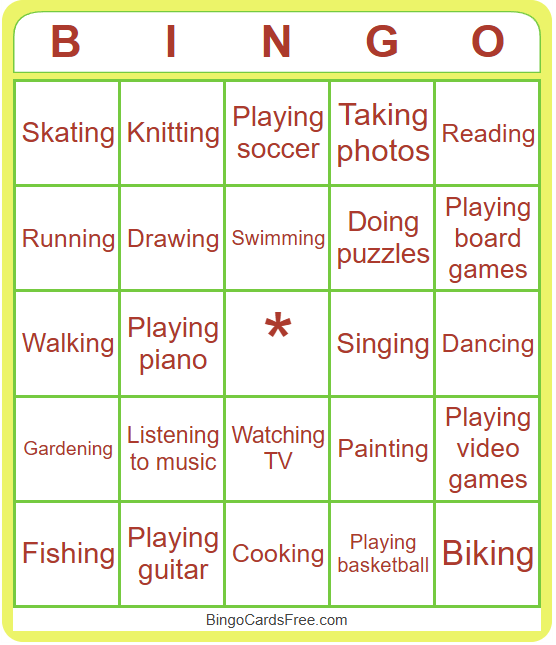
A classic game, meaning there are a hundred ways to do it. If you have older students, they’ll already be familiar with the game–though you may still need to direct students to get up and move.
Otherwise:
Give each student a different bingo card (you can print or draw them).
Call out the hobbies randomly.
Students mark the ones they have.
First to complete a row (horizontal, vertical, or diagonal) shouts “Bingo!”
The hard part is making the bingo game appropriate for the topic, vocabulary, and the grammar needed. The idea here is one student asks questions and another answers to practice.
Questions to ask yourself:
What grammar and vocabulary comprehension skills are needed?
Is this in pairs/small groups or a whole class?
What questions will students ask?
Do they have the grammar and vocabulary to do this?
What exact words will be on the Bingo-card?
Thanks to AI, you can make Bingo-card content easier than before–but you need to actually think about these questions. I have made the mistake of doing bingo for a beginner ESL class I was substituting* using a pre-made bingo-card that needed grammar conjugation of the words printed to form questions…the students were horribly confused. I learned a lot; the students didn’t. <(。_。)>
* (My experience to this point has been Advanced)
So let’s have a do-over with EXAMPLES!!!
BEGINNER
Mid-Beginner is the lowest level here. Once again, students need to be able to ask and answer questions.
QUESTION TYPE
Fill in the blank
Change verb-tense
(Choose one)
BINGO CONTENT
One word
Short phrase
(Choose one)
EXAMPLE
TOPIC: Hobbies
PRACTICE:
Do you like _______?
BOXES (ChatGPT Generated)
Reading
Dancing
Singing
Cooking
Drawing
Swimming
Playing soccer
Watching TV
Playing video games
Gardening
Biking
Fishing
Painting
Playing guitar
Running
Skating
Playing basketball
Taking photos
Walking
Doing puzzles
Playing board games
Playing piano
Listening to music
Knitting
STUDENT A: Do you like fishing?
STUDENT B: Yes, I like fishing. / No, I don’t like fishing.
ADVANCED
This one, you can do pretty much whatever you want–as long as it’s relevant to the lesson, of course. Have questions that demand a tense-change, have students use new vocabulary, have a mix of grammar and students need to figure out what tense is best to use for the situation, etc.
Some other ideas for variety:
Synonym / Antonym — This one would skip the questions and the teacher reads out words instead. Students have a bingo card with a synonym or antonym, and have to pick
Problem and Advice — Students come up with a problem. The bingo sheet has answers.